
 Posts
Posts


Today's Gazette reports the Appellate Court's rejection of Todd's appeal. It is a tragic decision that fertilizes injustice.
Gazette reporter Dennis Huspeni rightly reports our faith in Todd's innocence and our commitment to continue to fight for his exoneration. When he reports that Todd and Anthony Madril argued over a stripper, he is inaccurate. The record clearly shows that the perpetrator of that argument was Brad Orgill, the only person who was seen later fighting with Madril.
Huspeni also quotes Jeff Lindsey, the lead prosecutor on the case, who says, "This is an affirmation of the jury's decision." Lindsey is not burdened by one of those juror's recorded comments indicating that he didn't know if Todd had actually committed the crime.
One of the frustrating things about the appeal process is that it offers far less than a full consideration and review of all that can go wrong in a criminal investigation and trial. We've discussed on these pages how the juror's shocking admission is inadmissible.
We also remain highly critical of the way the District Attorney's Office investigated this case. Assistant District Attorney Amy Mullaney has yet to answer for her decision to cut a deal with Brad Orgill--the only person seen fighting with Anthony Madril--before the evidence in the case had even been sent to the state crime lab for analysis, and almost a year before the Metro Crime Lab determined that Orgill could not be ruled out as the assailant. The DA's office has also failed to explain the preferential treatment Orgill received just a few months after his deal with Mullaney, when Orgill was accused of rape. That accusation was cleared in a highly unusual collaboration between CSPD, Orgill, and Orgill's attorney that included a pretext phone call to Orgill's accuser to get her to drop the charges. Although Orgill's accuser was only 19, and Orgill admitted giving her alcohol (a clear violation of his plea agreement), the DA's office apparently never considered reviewing his non-compliance with the agreement. The effect of Orgill's preferential treatment was to preserve the credibility of a key prosecution witness.
Huspeni reports telescopically about Todd's knife, saying only that it had the victim's blood on it and a black spot that disappeared. There's more to it than that.
When the police first examined the knife, they found no blood on it. They found no blood in Todd's pockets where he had carried the knife.They did find black debris on it. More than a spot, it was described by the detective who examined the knife as "some kind of substance sort of shellacked on the blade.... It was in higher concentration along the serrated edge and most dense near the hilt of the knife." That suggested the knife's use to puncture a tire some 30 feet away from the area where the victim and Brad Orgill were engaged in a violent and bloody fight.
The knife was not shipped to the state crime with the other physical evidence. Some six months after the stabbing the state crime lab called the El Paso Sheriff asking where the knife was. It had been hiding out in their evidence room. So Officer Jeff Nohr drove it down to the state lab in Pueblo. At this point we'd been dogging the authorities for six months to test the debris on the knife because of its apparent exculpatory value.Unfortunately, by the time the knife arrived at the lab, the black debris was gone. We were never told of the missing debris, until in desperation, we obtained a court order 13 months after Todd's arrest, for the state to produce the knife for independent testing. Only when it reached the independent forensic lab did we learn that the debris was gone.
The authorities saw no blood on the knife until it showed up at the state crime lab. The amount was infinitesimal--so little that consumptive testing had to be approved. That is, it could only be analyzed by consuming the entire amount. This little amount of blood was located on the handle and away from the cutting edge of the folding knife. None of the victim's blood was in serrations on the knife or within the channel of the knife or the mechanism of the knife.
Particularly galling to us is that at trial Prosecutor Jeff Lindsey argued that Todd had cleaned the knife, after it was clear that any cleaning must have been done by the state, since it was while the knife was in the state's possession that the debris on the knife was removed.
We would like to know how the condition of the knife alleged to be the murder weapon became altered while it was in the possession of the El Paso County Sheriff's Department, and why this piece of evidence became separated from other evidence in the case and was "missing" in the evidence room for two months. Incidentally, at the time the Metro Lab did its analysis, they did not know about the problem with the knife evidence. They also didn't know that Orgill at trial would admit that on another occasion he had carried multiple knives and voiced an intent to use them should he find himself in a bar fight.
Finally, we insist that the state should not be permitted to gain a conviction by using evidence that has been altered while in the state's possession.
Monday, May 26, 2008
The Fight Goes On


Wednesday, May 07, 2008
John Newsome, Amy Mullaney, Poor Judgement, and Moral Decay
KOAA investigative reporter James Jarman's videotapes of District Attorney John Newsome and his deputy Amy Mullaney consuming the equivalent of a twelve-pack and a six-pack respectively during a time with interspersed office responsibilities made the headlines in the Colorado Springs Gazette this week. Then, they drove home, he in a government car.
Poor judgement? For sure. But it's just the tip of the iceberg. Thankfully, Newsome and Mullaney hold their liquor well enough that there have been no accidents (reported). But what about poor judgement on the job?
What about Newsome's elevation of Mullaney to deputy over others with more experience? Was it a decision based upon merit and accomplishment, or based upon drinking comraderie?
Has poor judgement on the job set the guilty free? Imprisoned the innocent?
Early in the morning of November 20, 2004, Anthony Madril shouted to his friends, "It's on! Let's go!" He entered into a fierce fight with Brad Orgill. Witnesses saw no one else near the fighting twosome. Madril emerged from it bleeding profusely--a single puncture to the heart, both ventricles breached. As his friend pulled him into the truck, Madril said, "I just got stabbed." Orgill's clothing was covered with blood, but before the state crime lab even tested it, Amy Mullaney cut Orgill a deal: deferred sentence. No jail time. Just testify against Todd Newmiller. No one had seen Todd near Madril. Madril's blood appeared no where on Todd's clothing.
So, Todd waits for the Court of Appeals to correct the excesses of bad judgment that led to his wrongful conviction. Orgill walks the streets, accused of rape since his deal. Details here.
Monday, April 14, 2008
Oral Arguments
Oral arguments in Todd's case were heard on April 10th in a special session of the Colorado Court of Appeals held at Denver University's Sturm College of Law.
Streaming video is available online, thanks to Sturm College.
After the hearing ended, the attorney's took questions from the law students in attendance. Most questions dealt with the nature of work done by appellate attorneys, one question was about the case.
The question we'd like answered is why did the DA cut a deal with Brad Orgill before all the evidence had even been sent to the crime lab--and almost a year before the Metro Crime Lab reported that Orgill could not be ruled out as the assailant.
We've tried to approach that question in the series of blog entries here titled "How an innocent person is convicted." It seems, though, that this is a question the prosecution needs to answer--we can only speculate.
Friday, April 11, 2008
Exculpatory Evidence
For Todd's family and friends, the hearing of oral arguments was a stressful occasion. Our attorney had but 15 minutes to address the court. Most of that time was taken up with questions from the three-judge panel.
The questions centered upon an evidence issue: the loss of deposits on what prosecutors alleged to be the knife used to kill Anthony Madrill.
Previous posts (Altered Evidence and Altered Evidence: How the State Explains the alteration of evidence in its possession) have touched on this evidence issue.
Intuition tells most of us that relying upon evidence that has been altered is a bad idea--especially when the claims derived from the altered evidence are at odds with all other physical evidence.
Legal consideration of this point, however, is more complex.
The alteration of the knife in this case involved the loss of a deposit on the knife widely accepted to have been tire debris.
To determine if that loss unfairly prejudiced Todd's defense, the court uses a three-part test:
- Was the state responsible for the loss?
- Did the lost or destroyed evidence have an exculpatory value that was apparent at the time of its loss?
- Is comparable evidence unavailable to the defendant?
Questions from the judges at the oral argument focused on the second part of that test: did the material have an exculpatory value that was apparent at the time of its loss?
The judgment of the police regarding the knife's exculpatory value can be seen by examining their statements and actions in light of the context they understood at the time the evidence was received by them.
Getting to the context is simplified because it was very early in the investigation—their data-field was pretty limited. A look at the early timeline reveals a context where the deposit on the knife was especially significant.
The knife was retrieved from Todd on the afternoon of November 20, 2004. The investigating officers' question at that time had to be if the knife was the murder weapon. Earlier that morning Det Frady had interviewed Charles Schwartz, an interview that clearly points to Brad Orgill as the person who fought with Anthony Madril. Schwartz tells them:
- The only people physically fighting are Madril and the person later identified to be Orgill. The person later identified as Todd is not seen around Madril. Schwartz explains that Todd was on the passenger side of the vehicle while Madril and Orgill were on the other side and about 20 feet up the road.
- The fight between Orgill and Madril looked pretty even to Schwartz. Todd is the person who punctured the right-rear tire on his truck; Orgill is the person Anthony is enthusiastically fighting in front of and to the left of his truck.
- He (Schwartz) agrees with Frady’s hypothesis that “there were two knives”—one used to puncture the tire, the other used to stab Madril.
Frady conducted a second interview with Schwartz on the morning of 22 November. It’s clear from the 22 November interview with Schwartz that Frady is testing the two-knife hypothesis when he asks Schwartz repeatedly and in detail to go over the sequencing of the fight between Orgill and Madril and the timing of the puncturing of the tire.
- Schwartz confirms what he’d reported in his first interview.
- Schwartz explains very clearly and under detailed questioning that Madril fought hard with Orgill at the same time that the tire was punctured.
Frady’s 22 November interview with Schwartz occurred at 1030 a.m. An hour and half later, Det Vanderpool goes to the evidence room and inspects the pockets of the leather jacket Todd had worn. Specifically, he is looking for anything that “appeared to be blood.” The reason for this inspection is clear: blood stains in the pocket, where the knife had been stored, would connect the knife to the stabbing. However, the pockets did not have any blood stains.
Against this background Richer and Nohr discussed the best way of preserving the black deposit on the knife.
What we see within the context of these actions by the police is an attempt either to rule the knife in or to rule it out as the murder weapon. The investigation of transfer between objects at a crime scene is an important part of every detective’s training. All investigative officers (and even lay observers in this case) would recognize the importance of the deposits on what is purported to be the murder weapon. Anyone would recognize that in considering the “two-knife” hypothesis, where one knife is used to stab a person and another used to puncture a tire, that investigation of deposits of blood and “black debris” would be central to determining how a particular knife had been used. Clearly, deposits of blood would have been inculpatory while deposits of tire material would have been exculpatory.
Actually, any deposits would be exculpatory because they would indicate that the knife had not been scrubbed by Todd—guilty behavior that the prosecutor and state’s witnesses suggested at least three times during the trial.
Monday, April 07, 2008
How an Innocent Person is Convicted, Part 13: A jury that doesn't understand presumption of innocence or reasonable doubt
Despite the prosecution's use of altered evidence, and their attempts to confuse the jury, we approached the verdict with confidence. How could they find Todd guilty when no one ever saw him near the victim, when everyone saw Brad Orgill fighting fiercely with the victim? How could they believe that the only person seen fighting the victim, who was covered in the victim's blood, was not the more likely assailant? How could they believe that a person could be stabbed in the heart and then just fly off to fight with someone else, shouting, "It's on! Let's go!"? How could they believe that an assailant would walk up to someone, stab him in the heart, and then refuse to take a swing at a second person who was egging him to fight? How could they think that an assailant who'd stabbed someone in the heart would have none of that person's blood on his clothing, not even in pockets that held the alleged murder weapon?
We were stunned when the guilty verdict came.
The pain we still feel over the jury's decision to convict grew to include unbounded frustration when we learned of an interview with one of the jurors.
On the eve of Todd's sentencing Brian Arnot interviewed one of the jurors:
Q: Do you think beyond a reasonable doubt that he did do it?You can hear the context of that admission by clicking here.
Juror: I don't know....
We've played that audio recording for a number of people. Their response is always a sarcastic "so that's a jury of one's peers."
Unfortunately, the audio file you can listen to on the Internet is out of bounds for the judges. Such comments are inadmissible under Colorado's rules of evidence. Ironic, isn't it, that the trial court in Todd's case had no difficulty accepting into evidence a purported murder weapon, the condition of which had been altered while it was in police custody, but clear evidence that the jury did not understand its responsibilities is inadmissible.
The absence of a cure for juror incompetence should suggest to us all that juror education needs to become a higher priority.
Sunday, April 06, 2008
How an Innocent Person is Convicted, Part 12: Detective Jeff Nohr "clarifies"
The lead investigator was El Paso County Sheriff's Detective Jeff Nohr. He sat with the prosecutors and if a prosecution witness said something inconvenient for the prosecutions, Nohr would take the stand and "clarify." Here we document but one of his "clarifications."
Detective David Yarbrough searched the crime scene with his K-9, Ivor. Of course, one of the main things he was searching for would have been any kind of weapon, especially a knife. When asked to define the area of his search, he said that it was between the crime scene tapes that had been set up. Police photos show that these tapes were set up across Conrad Road. Here's a police photo showing the northern boundary of the crime scene (click on the photo to see hi-res original):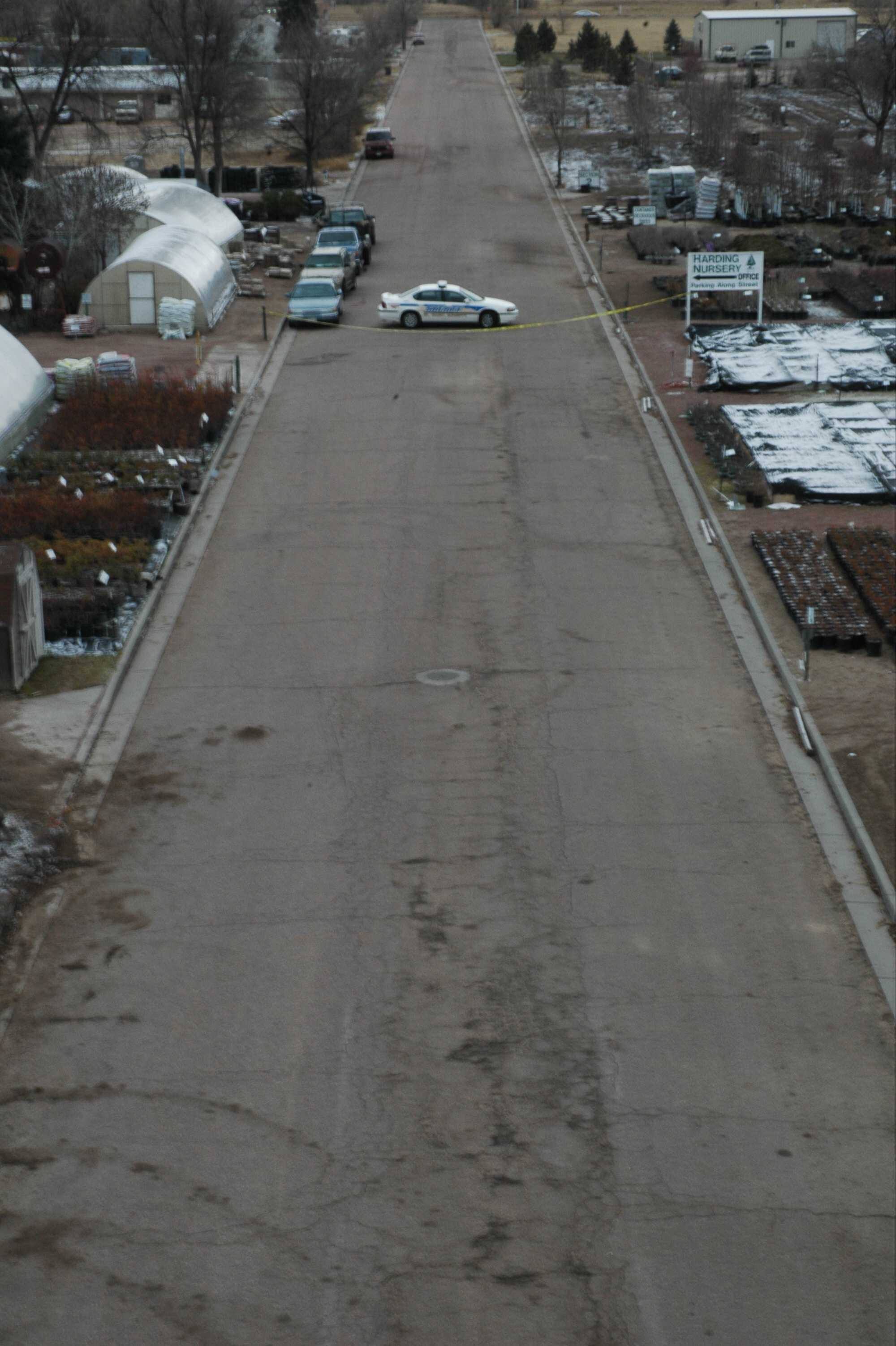
And here's a photo of the southern boundary (You have to look closely to see the yellow tape tied to the stop sign):
It's important to note that the tape only defines the northern and southern boundaries of the scene. No tape was set up alongside the road.
Det Yarbrough, when asked how far off the pavement he searched, replied "Would have been about 15 feet on either side of the pavement 'cause I had him on a 15-foot lead."
The answer seems to be honest and based upon fact, especially because he tells us how he recalls the distance.Of course, 15 feet is far short of the distance most could throw a weapon such as a knife.
On redirect, Yarbrough maintained his description of the search area:

Prosecutor Stephanie Rikeman Q. You did search off either side of the curb on Conrad Street?
A. Yes, I did.
Q. About how far?
A. Within the banner tape.
Clearly, Yarbrough was quite sure of the area he searched, but the implication that the search had not been as thorough as it should have been brought Jeff Nohr to the stand later that afternoon. You be the judge if his testimony is "clarification" or damage control.
Nohr testified, "So I asked Deputy Yarbrough to utilize his dog all through this area as well and then on the west side of the road through these larger trees, again, with all the mulch. And then Deputy Yarbrough went down to the east of the intersection with his dog to the Appaloosa Gentlemen's Club searching both sides of the road in that area. And it was described Deputy Yarbrough basically was to search within a certain area, within arm's throw of how far somebody could throw something."
Notice how carefully Nohr words his testimony. I'm sure he'd maintain that he was just "clearing up" any questions about the area Yarbrough was told to search. Though, Nohr does seem to slip in his second sentence, when he maintains that Yarbrough actually searched all the way "to the Appaloosa Gentlemen's Club," which is about a quarter mile beyond the confines of the police tape. How confusing might this testimony be to jurors? Does it seem like a trick to get the jury to think that the search for another weapon was more thorough than it actually was?
So it seems.
Friday, April 04, 2008
How an Innocent Person is Convicted, Part 11: Wait a year to perform a crime scene analysis; do it without all the evidence; then ignore its findings
As soon as Todd was charged, we pushed the police and prosecution to investigate the stabbing of Anthony Madril thoroughly. We accepted many delays to accommodate the state's slowness in processing forensic evidence.
We especially wanted the state to examine the blood stain on Todd's jacket, which we knew would be his, not the victim's. And we wanted the state to examine the black debris Detective Richer had seen on Todd's knife. We knew that it had to be from the puncturing of the right tire of Schwartz's truck, and that placing Todd at the right-rear of Charles Schwartz's truck while Brad Orgill and Anthony Madril fought fiercely to the front and left of the truck was important to understanding clearly what happened that terrible night.
But the state declined to perform DNA testing of Todd's clothing. Instead, they decided to test a blood-stained shirt that Orgill had given Todd to wear the day after the stabbing. (The DNA analysis of that shirt conclusively determined that the blood on it belonged to an unknown person.) The state never tested debris on the knife either.
So, after 14 months had passed, we obtained a court order to have the knife and Todd's jacket sent to an independent lab for testing. That lab confirmed that only Todd's blood appeared on his jacket. The shock for us, though, was learning at that time that the debris reported to have been on the knife when it was first examined by the police was now gone. We then learned that the debris was actually known to be missing seven months earlier while in the state's possession.
It was during this time--when the independent lab was doing this testing--that the Colorado Springs Metro Forensics Lab finally performed the only state-sponsored "crime-scene analysis."
Of course it was too late for them to analyze the debris that had once been on the knife.
When Kimberly Bjorndahl, one of the report's authors, testified, she repeatedly claimed that the victim had but one wound, the fatal stab to his heart, but the autopsy clearly shows that the victim also suffered incised cuts (defensive wounds) to his hand and a cut across the bridge of his nose. The failure to note these basic injuries, of course, raises questions about the adequacy of the resulting analysis, and, in particular, how much attention was paid to the autopsy.
Nevertheless, the report states in its closing paragraph that Brad Orgill cannot be eliminated as Anthony's assailant.
The report reasons, though, that Orgill is less likely to be the assailant because there is no evidence that he'd carried a knife. However, at trial Orgill admitted to carrying three knives in the past, and on one occasion being ready to use a knife should a fight erupt in a bar he frequented.
None of the three knives Orgill admitted carrying were recovered by police when they searched his house.
Saturday, March 29, 2008
How an Innocent Person is Convicted, Part 10: Preserve the credibility of prosecution witnesses at all costs
Astonishingly, the star witness for the prosecution was Brad Orgill--the only person ever seen fighting with Anthony Madril. Madril entered the fight with Orgill enthusiastically, shouting "It's on! Let's go!" An amazing amount of enthusiasm for someone who, according to the prosecution, had been stabbed through both ventricles of his heart.
Further, Madril emerged from the fight with Orgill bleeding from his chest wound and in his dying breath told his friend Chas Schwartz he'd "just been stabbed."
It was Brad Orgill who testified for the prosecution against Todd. Brad Orgil who'd received a deferred sentence (read "no prison time") in return for that testimony. And Brad Orgil who'd been accused of rape just a few months after receiving the deferred sentence.
The rape accusation threatened to damage Orgill's credibility, but the defense attorney's were not provided with any documentation of the accusation until after Todd's trial.
The accusation was resolved with a highly unusual collaboration between the investigating officer, Colorado Springs Police Detective David Krueger, Brad Orgill, and Orgill's attorney Bill Shoewe. As they gathered to carry out this mission, they discussed Shoewe's trip to Sturgis, South Dakota, and then made a pretext phone call to Orgill's accuser and got her to drop the charges against Orgill.
After Todd's conviction, we petitioned for any records regarding the rape accusation against Orgill. The prosecuting attorney in Todd's case denied any knowledge of this event (or of a previous sexual assault accusation that had cost Orgill his job at the University of Colorado Springs a few years earlier). The profession of ignorance by the DA's office is not consistent with the existence of documentation that committed the DA's office to pay for the rape examination at Memorial Hospital as well as the existence of a release form signed by the accuser authorizing release of the examination to the DA's office.
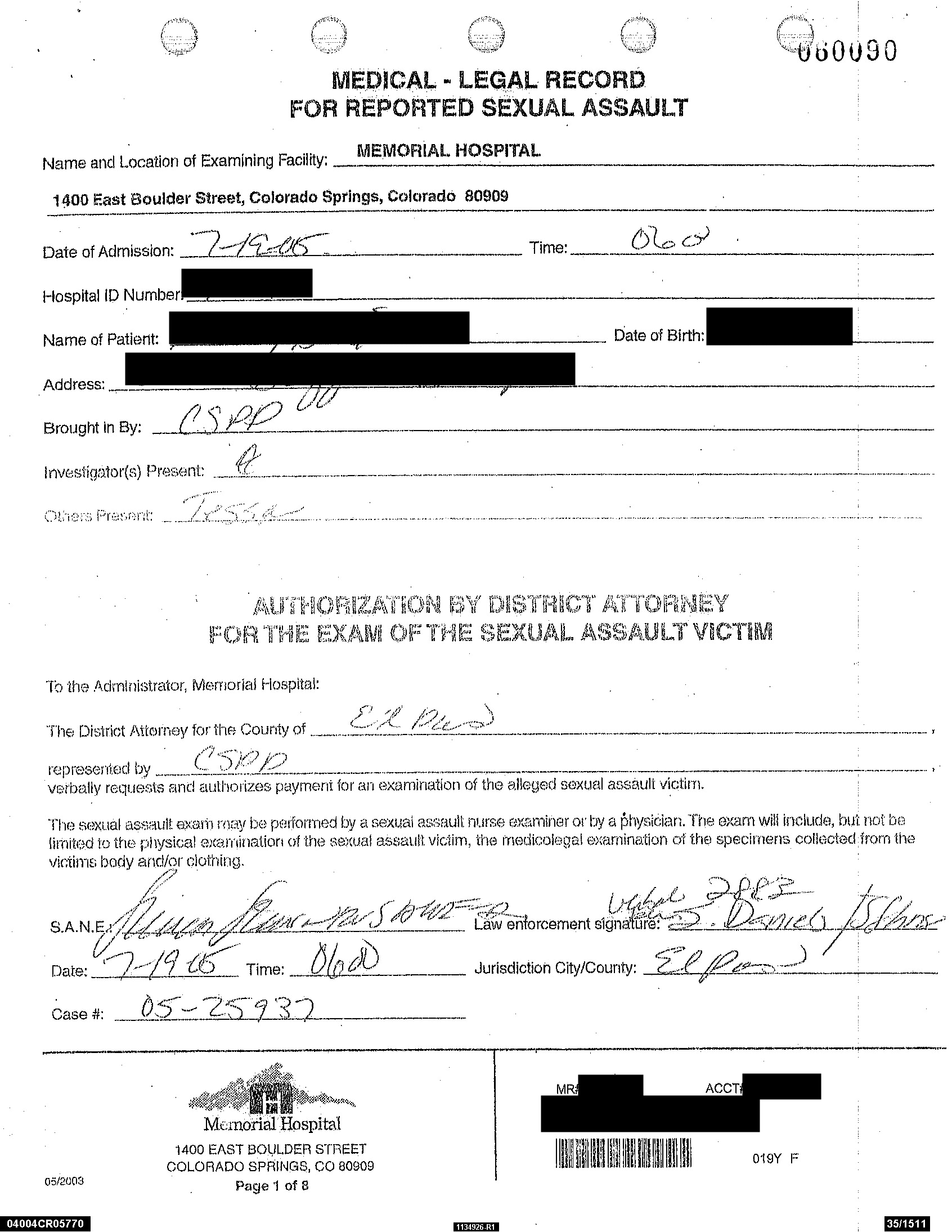
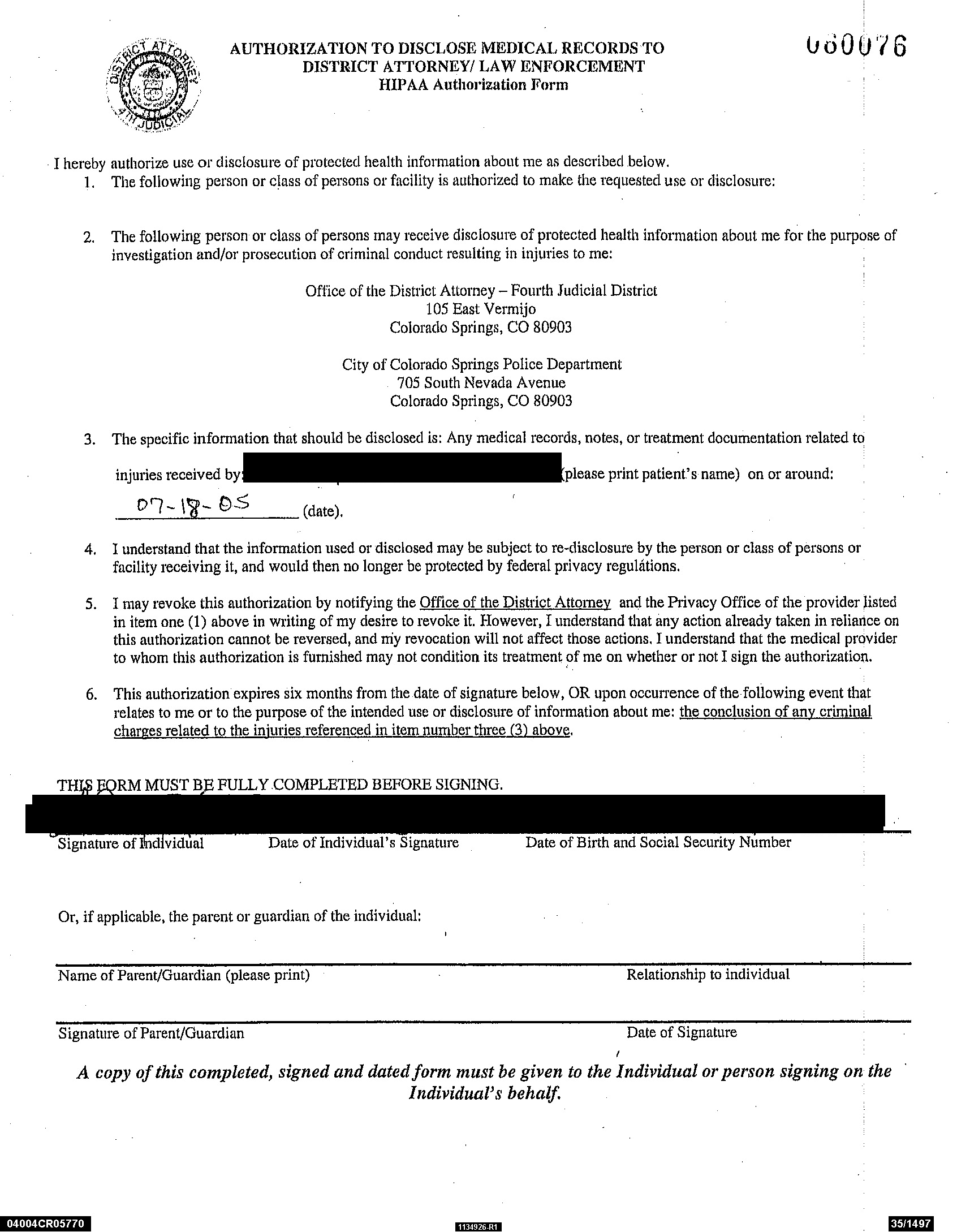
Orgill claims that the sexual encounter with the victim was consensual, though he admits to providing the nineteen-year-old woman with alcohol--a clear violation of his deferred-sentence agreement. The threat of losing his deferred sentence and facing prison time (likely 18 to 24 months) hung over his head when he testified for the prosecution at Todd's trial.
The record below suggests how the prosecution was able to preserve Orgill's credibility after being accused of rape, by placing a pretext phone call to the accuser on August 18, 2005. Then by delaying any further action, they were able to keep pressure on their witness and preserve his testimony without having to release information about his rape accusation. Finally, after the conviction, when the defense raised concerns about Orgill's credibilty, the DA's office proceded with charges against Orgill's accuser. The nineteen-year-old woman whom Orgill had given alcohol and who'd accused Orgill of rape then became a perpetrator in the eyes of the District Attorney's Office.
7/19/2005 -- The rape accusation.
8/18/2005 -- A pretext phone call to the accuser, charges dropped.
3/16/2006 -- Todd is convicted at trial. Over the coming weeks his attorney's try to locate any record of the rape accusation. Their requests are ignored until they file a formal motion for the information.
4/25/2006--The young woman who'd accused Orgill of rape is arrested for false reporting of a crime.
5/08/2006--Summons and complaint against the young woman is filed. Arraignment is scheduled for 6/6/2006.
5-17-2006--Judge Gilbert Martinez signs a court order demanding the DA's Office provide any discovery documents related to an investigation of Orgill regarding sexual assault.
5-19-2006--The DA provides Todd's attorney with the discovery documents.
5-24-2006--Just prior to Todd's sentencing hearing Prosecutor Jeff Lindsey says, "we were never notified of this investigation. And I think the dates of the investigation are important for the record and for the Court to consider. The investigation began on July 19th, 2005 and was disposed or no filed by the police department [in] September of 2005. Well, Judge, that was the end of that case as far as the police department's concerned. The ticket for Ms. Alleged Victim was placed in the police department file. I have been told that she's been served, not by Detective Krueger but by another officer when she was picked up."
The timing of the DA's actions against Orgill's accuser is especially convenient: It kept pressure on Orgill until after the trial. Then when questions could be raised about the propriety of relying upon an alleged rapist, the DA demonized Orgill's accuser (the nineteen-year-old given alcohol and sex) and turned her into a perpetrator.
Todd's defense attorney summed it up by saying:
There's no information that Mr. Orgill knew [his accuser] was charged or was going to be charged. But the fact is that this man had this hanging over his head when he testified and this was information that he had; certainly would be more cooperative with prosecution and the police; certainly wanting to put himself in a better light; certainly wanting to say things to make him the best witness he possibly can be for the prosecution, going to his bias, interest, motive to lie to protect himself, not only from being charged with sexual assault or contributing to the delinquency of a
minor, because in the statements there's statements that he's providing alcohol to a minor and having sex with her, but also what it would do to the deferred sentence.
Thursday, March 27, 2008
How an Innocent Person is Convicted, Part 9: Only look at some evidence
Once the District Attorney's office decided to pursue a conviction against Todd, all interest in pursuing truth seemed to evaporate.
The real-life world of crime analysis is not like CSI. In real-life, the prosecutor directs the forensic analysis, asks for specific tests on specific items that may support the prosecution's case. Tests that the prosecution fears might undermine its case can be avoided.
For example, in Todd's case the prosecutor (Jeff Lindsey at this time) declined DNA testing the clothing Todd had worn during the confrontation on Conrad Street. Eventually, we obtained a court order to have this clothing tested at our expense. Those tests confirmed what we'd known all along regarding the blood stain on Todd's leather jacket: it was Todd's blood. None of the victim's DNA has ever been found on any of Todd's clothing.
Although Lindsey declined to test the clothing Todd had worn that night, he did order the testing of a shirt that Todd had worn the day after--a shirt that had been given to him by Brad Orgill.
Brad's choice of shirts to lend to Todd is curious. Although he had many shirts to choose from (he ran an online clothing sales business from his house), he chose to give Todd a plaid shirt with human blood stains on it.
Lindsey had the blood stains from that shirt tested, but the blood did not match anyone who was present at the stabbing.
Why had Orgill lent a shirt with blood on it to Todd? Why had Lindsey declined to test the jacket Todd had worn that night? Was it so he could simply claim that Todd had blood on his clothing--never mind whose? Patricia Van Horn in the brief she submitted on behalf of the state in Todd's appeal refers to the blood on Todd's clothing in an attempt to imply that he had contact with the bleeding victim. Of course, she fails to mention that none of the blood on Todd's clothing came from the victim, or even that the state declined to perform testing that was surely called for.
Apparently if the search for truth might get in the way of a conviction, the search is abandoned.
How an Innocent Person is Convicted, Part 8: Conclusions before research
A long time college professor, I've always been frustrated by a few students who seem to feel that they've already got it figured out. You've probably suffered through their presence in classes you've taken. Often, they're ideologues (from anywhere on the political spectrum). Theirs is a cockiness that can only come from uninformed opining.
They are the students who turn in a first draft containing nothing but their unsupported opinions and then go to work seeking in the library (or more likely online today) whatever factoids might support their preconceptions. They give scant or no attention to anything that might challenge their beliefs.
Such is the kind of thinking and approach the authorities seem to have taken in investigating and prosecuting Todd.
For us, the process was quite different. I'll never forget the night Todd was charged with murder. I called my boss, an Air Force Colonel, and told her that "in my heart I can't believe he did it." I'd have to see the evidence, though, before I could know with my head.
The intellectual knowing came a couple weeks later, when the police released the first volume of discovery in the case. Only then did we learn that the victim had been fighting with Brad Orgill, not with Todd. Only then did we learn that no one had seen Todd near the victim.
Surely, we thought at the time, the police and prosecutors will look at the evidence that's been gathered, will analyze it logically, will reconsider the rushed decision made to indict Todd.
But they didn't.
Todd's attorney met with prosecutor Amy Mullaney and lead investigator Jeff Nohr, and he went over the eyewitness statements, including those which are archived on this web site, statements that pointed away from Todd as the perpetrator. But Mullaney had begun to think like one of those students whose mind has been made up, who's not going to let the facts get in the way.
She responded adversarially.
A short time later, still months before the forensic analysis would be complete, Mullaney offered Orgill a deferred sentence in exchange for testimony against Todd. That decision, not the facts of the case, eliminated Orgill from consideration as the assailant, and it left Todd as the sole focus of the ensuing investigation.
Tuesday, March 25, 2008
How an Innocent Person is Convicted, Part 7: From Witness to Suspect
Brad Shannon's initial claim that "Brad Orgill had stabbed and killed someone" was consistent with the early actions of the police. When Todd and Brad were apprehended, it was Brad who received their closest attention.
So, what made the police come to consider Todd as a suspect?
It's a tough question to answer, because much of what goes on in a police investigation is hidden from view.
But we do know the police were frustrated by our insistence on legal counsel. We also know that after speaking with us, the police interviewed Mike Lee, who was one of the witnesses.
Lee knew few details. He's seen Todd confronting one person, Orgill fighting with another. He knew that someone had been stabbed but not whom . And he knew that Todd had carried a knife that had been used to puncture a tire. Lee would become a witness for the state.
Jason Melick, another witness learned someone had died by watching the TV news. Melick was a big drinker that night, starting off with 12 beers before moving on to the hard stuff. His memories were dramatic and inconsistent with everyone else's. At two a.m.--24 hours after the stabbing--he called anonymously to the crimestoppers' phone number and left a five word message: "the killer's name is Todd."
On the Monday after the stabbing, Brad Orgill showed up at the Sheriff's Office with his lawyer. Orgill, who had been the only person seen fighting with the victim, now pointed the finger at Todd.
The day following Orgill's interview, Prosecutor Amy Mullaney rushed to charge Todd. The forensic analysis of the physical evidence had hardly begun, and little attention had been given to the eyewitness reports of the victim's friends, but the indictment was made. As the analysis of witness statements and physical evidence dribbled in supporting Todd's innocence, Mullaney would resist any reconsideration of her rush to indict.
A key piece of physical evidence, the tire punctured with Todd's knife, received its analysis over two months after Mullaney cut her deal with Brad. By timeline produced by both the prosecution and defense, the puncturing of the tire had to have occurred after the stabbing of the victim. Had the same knife been used for both the stabbing and puncturing, then blood would have been transferred to the tire. But it wasn't. Despite extremely sensitive tests for the presence of blood on the tire, none was found. Shortly after receiving this news, Mullaney handed the case over to a younger prosecutor, Jeff Lindsey.
Counting the innocent
Adam Liptak, writing in today's NY Times, thoughtfully discusses the question of how many are wrongfully convicted.
Supreme Court Justice Antonin Scalia using last years' argument by Morris Hoffman (discussed earlier on this blog) defends the reliability of the judicial system, but the hard math and research by Samuel R. Gross, a law professor at the University of Michigan, are both convincing and troubling. Liptak writes:
Professor Gross concluded that the false conviction rate for death row inmates has ranged from 2.3 percent to 5 percent. Were even the lower end of that range applied to people who received prison sentences of a year or more in the last three decades, he wrote, it would suggest that about 185,000 innocent people have served hard time.
Liptak goes on to point out that
Justice Scalia, for his part, focused on what he saw as good news. “Reversal of an erroneous conviction,” he wrote, “demonstrates not the failure of the system but its success.”
For Todd's sake, and for the sake of Justice, we hope that the system will "demonstrate its success" when it reverses his erroneous conviction.
Thursday, March 20, 2008
How an Innocent Person is Convicted, Part 6: We learn a little more
Todd told us that after he exited the Jeep, he'd gone directly to confront a person standing just outside the passenger's door of the pickup, which we'd later learn belonged to Chas Schwartz. We'd also learn later that the person he confronted there was Chisum Lopez.
Lopez would testify at the trial that he was confronted by Todd about "a half a second" after getting out of Schwartz's pickup. Lopez would also say that he wanted to fight Todd, but that try as he would, Todd wasn't willing to take a swing.
Although Lopez never admitted to taking a swing at Todd, Todd told us that Lopez did hit him in the face, just before jumping back into Schwartz's pickup and locking the door. Todd, angered by the punch, took out the knife, which he had used earlier in the day to open boxes of merchandise he'd received--clothing that he retailed online through an ebay business he and Brad Orgill ran. In retaliation, Todd used the knife to puncture the right rear tire of Schwartz's truck.
At the time Todd us this, none of us knew who had been killed. Not until the release of the police reports a couple weeks later would we learn that it was the person Brad had fought so violently who had died.
Wednesday, March 19, 2008
How an Innocent Person is Convicted, Part 5: We learn a little
Joel was the first son to speak with us about what he witnessed. He'd parked his Jeep behind Chas Schwartz's pickup truck, which was stopped on Conrad Street, a dark empty street a couple blocks from the club parking lot where the two groups of young men had joined in a verbal confrontation.
Joel watched as Brad Orgil fought with his opponent on the driver's side of Schwartz's pickup and as Todd faced off with a second person on the passenger side of the pickup. The whole confrontation ended quickly, "within a minute or so," Joel said. Surveillance camera video that is a part of the police record indicates that the total time could not have exceeded 75 seconds.
Afterwards, all parties returned to their respective vehicles and drove off. Todd had a couple of superficial nicks on his cheek, which caused blood to stream onto his neck and shoulder. Joel was upset and angry that his brother had been hurt and wished to pursue Schwartz's pickup, but Todd did not. Joel thought that Todd was trying to calm him down when Todd told him that he'd stabbed one of the tires.
We'd have to wait until Todd spoke to find out why he'd stabbed the tire.
We'd wait even longer to find out that the person Todd had confronted was uninjured, and, in fact, untouched.
Weeks would pass before we'd learn that the person Brad Orgill fought on the driver's side of the Chas Schwartz's pickup was the one who'd been killed.
Monday, March 17, 2008
How an Innocent Person is Convicted, Part 4: The Rule of Silence
The business of defense attorneys is mostly one of cutting deals. Nationally, about 85% of cases are plea-bargained. Of those that go to trial, contention often depends upon issues of mitigation rather than innocence. Defense attorneys will tell you that the scariest case for them is the one where they are defending an actually-innocent person. To lose such a case is to lose everything. Yet, their sharpest skills--the ones they use daily--are those for negotiating, not those needed for winning.
Defense attorneys are worriers. Theirs is the job of wondering the "what-if's." What if the client does something unrelated but stupid while the case is under review, what if some crackpot or old enemy shows up with an incriminating comment? What do the police know that that defense doesn't know?
Defense attorneys advise clients to play it safe. Keep mum, avoid the press, don't talk to anyone about the case. Todd's attorney told us not to talk to him about what happened that night. "There's no parent confidentiality privilege," he said.
But how could we not talk?
Sunday, March 16, 2008
How an Innocent Person is Convicted, Part 3: From Witness to Suspect
Officer Brad Shannon wanted Gloria and me to to tell our sons to speak with detectives without an attorney present. He told us they were just witnesses, that Todd had just been in a stare-down with another young man, that there was some trash talk, but Todd hadn't done anything. But he needed our encouragement to tell the police what he knew.
Our heads were spinning. Less than an hour earlier, another detective had told us that there'd simply been a minor tiff. But now we knew that someone had died. Why had the police lied? We were way out of depth and needed help. We knew we needed to retain an attorney.
Our decision was firm: we'd not advise Todd or Joel to speak without cousel, which we'd retain immediately.
Shannon's response: "If you don't cooperate"--meaning if you get an attorney--"we'll start looking at your sons as suspects rather than witnesses."
It was both a threat and a promise. In Colorado Springs exercising one's right to counsel is tantamount to self-incrimination.
Saturday, March 15, 2008
How an Innocent Person is Convicted, Part 2: Cultivation of Ingnorance
The cold gray November day flowed in from the street as I opened the door of our house to what turned out to be a plainclothes detective from the El Paso County Sheriff's Office. The chill followed him inside. "We want to talk to your son, Joel," he said.
Joel was at his apartment near the Colorado Springs campus of the University of Colorado, where he was working on his since-finished degree in chemistry. We asked why the detective wanted to speak with Joel. The answer seemed less than forthcoming. The detective said Joel had witnessed an event the preceding night--not a big deal, the detective said, "just a minor tiff--no not even a minor tiff." Just a trivial thing.
It sounded disingenuous. If this event were so minor, why a plainclothes officer, why a Saturday afternoon?
Gloria, my wife, called Joel at his apartment and told him to come to our house. When Joel arrived, the detective wanted Joel to come downtown with him. We demurred. The detective retreated to the cul-de-sac in front of our house.
Inside, the phone rang. Gloria took the call upstairs. Afterwards, she called to Joel and to me, "That was Officer Shannon from the Sheriff's Office. He said that last night Brad Orgill stabbed someone and killed him. They need to talk to Joel and Todd as witnesses."
Thursday, March 13, 2008
How an Innocent Person is Convicted, Part 1: the forgotten witness interview
When a member of your family languishes in prison for a crime he didn't commit, you find youself haunted by the simple question: Why? I've spent my whole working life sworn to defend the constitution--as a military pilot, a member of the FBI, a professor at the Air Force Academy. To see a wrongful conviction firsthand is a tragedy that is multiplied by the high expectations I'd come to have for American justice. I still believe in our founding principles, but I've come to realize how imperfectly we've implemented them.
The path to wrongly convicting Todd began early on the day Anthony Madril died. Detective Ricky Frady interviewed one of the most important witnesses, Chas Shwartz. Schwartz sat in the driver's seat of his pickup while Madril and Orgill battled in front of him and while Lopez and Todd confronted each other just outside the passenger-side door. A file containing a transcript from Frady's interview is available online.
In his initial report of the this interview, Frady writes (in error) that the videotape machine had malfuntioned, so he had only his memory and notes to go on. As a result the report is sketchy and fails to mention details that reveal the sequence of events that night. If you read the actual transcript of the interview (taken from the videotape, which, it turns out, had been recorded after all), you'll see how Frady focuses on exactly where Todd was and where Madril was and how Madril was fighting with Orgill. Much of that detail failed to make it into Frady's initial report. In fact, Frady would not actually view the videotape for another year and a half. In the meantime, the police were not able to consider this important eye-witness account, which provided significant detail that was exculpatory for Todd.
Next: Part 2--Ignorance leads to more ignorance.
Wednesday, March 12, 2008
The Prosecution's Theory
We felt confident that the prosecution at Todd's trial would not be able to show how Todd could have possibly stabbed Anthony Madril. After all, Todd had never gone forward of the pickup truck in front of which Anthony Madril and Brad Orgill fought so violently. Todd had been engaged non-violently with Madril's friend Chisum Lopez the whole time.
Both Lopez and Madril's other friend Chas Schwartz placed Todd at a considerable distance from Orgill and Madril as Madril shouted "It's on!" Madril and Orgil were the only two seen in a physical confrontation. When that confrontation was over, Madril emerged bleeding from his chest and told his buddies, "I've just been stabbed."
The prosecution presented their entire case--nearly two weeks of testimony--and never once did they specify exactly when or how the stabbing took place. Not until their closing argument, after the defense had rested, did prosecutor Stephanie Rikeman reveal their fabulous theory:
Todd runs up to Madril, a meeting that is unseen by any of the six witnesses, and stabs him in the heart, tearing open both ventricles. Madril then goes off to fight enthusiastically with Orgill and Todd goes on to a non-violent confrontation with Lopez.
That the prosecution waited until the closing argument to voice this theory can only suggest that they didn't want anyone to think about it for too long. Beyond the obvious question of one's ability and interest in engaging with a second person after just being stabbed in the heart, the prosecution's theory also raises many other questions:
- Why would Madril yell "It's on" instead of announcing that he'd been stabbed?
- Why didn't anyone see this confrontation? Did six other young men find something else more interesting to watch?
- Why would a person suddenly stab someone in the heart and then just put the knife away and limit himself to verbal jousting?
- Why would Todd not have blood transferred to his clothing--especially to his pockets where he kept the knife?
- Why does the trail of Madril's blood begin and end with the trajectory of his confrontation with Orgill?
- Why was Todd never seen in the area that contains the trail of Madril's blood?
Because the prosecution's theory came so late in the trial, it became even more important that the defense be accorded an opportunity to have a fully-developed theory of defense instruction for the jury.
Tuesday, March 11, 2008
The Theory of Defense Instruction to the Jury
The entitlement to a "theory of defense" instruction helps balance the advantage the prosecution gains by being able to set the pacing and agenda of a trial. The prosecution decides which witnesses to call and when to call them as the case is made. In other words, the prosecutor determines the plot of the story being told to the jurors. That can disadvantage the defense as it battles the prosecution's interpretation of evidence and testimony while at the same time trying to advance its own understanding of what happened.
In Todd's case the defense was hampered by the loss of a central piece of evidence--the condition of the knife that the prosecution alleged to be the murder weapon. That disadvantage was compounded when the trial judge refused the theory of defense instruction proposed by the defense attorneys. One of the key elements of the rejected instruction was the defense theory of how the knife came to have a minute amount of blood on it. The judge's reason for refusing the instruction (that the evidence supporting the theory was not "ample") is not consistent with the legal standard. (The details are available in the appeal briefs). In truth, the trial record offers considerable supporting evidence for the instruction offered by the defense.